
How to Identify Original Himalayan Shilajit: 6 Checks Before Buying
Learn six practical checks for examining Himalayan Shilajit resin, sourcing, packaging and laboratory reports—and why visible, well-documented resin is HarvestLo’s premium choice.

How to Identify Original Himalayan Shilajit: 6 Checks Before Buying
Texture and solubility can reveal warning signs, but trustworthy Shilajit is ultimately about the resin, its source, its pack and the evidence behind it.
The quick answer: original-looking Himalayan Shilajit resin should be dark brown to nearly black, temperature-responsive, distinctively earthy and able to disperse in warm water. But no burn, stretch or water trick proves authenticity. Choose resin with traceable sourcing, complete packaging and a recent batch-specific laboratory report.
Why genuine Shilajit is difficult to judge by appearance alone
Shilajit is a complex natural substance associated with mountainous rock environments and used traditionally in Ayurveda. Its composition can vary with geography, raw material and processing. Purification also matters because material collected from the environment can contain unwanted contaminants.
This natural variation is exactly why internet shortcuts are unreliable. A syrup, plant extract or coloured paste can be made to stretch or dissolve. The goal is not to find a resin that performs a dramatic trick; it is to find a responsibly prepared product whose physical qualities agree with its documentation.
| What to examine | Reassuring signs | Reasons to pause |
|---|---|---|
| Form | Dense, glossy resin presented in a sealed container | Unidentified loose powder or unlabelled paste |
| Texture | Firm in cooler conditions and softer with warmth | Always watery, gritty or suspiciously rubber-like |
| Aroma and taste | Strong earthy, mineral or smoky character; naturally bitter | Added perfume, sweet flavouring or solvent-like smell |
| Warm-water behaviour | Gradually disperses into a brown or amber-toned liquid | Bright artificial colour, oily separation or floating plastic-like mass |
| Evidence | Clear batch details and a report that matches the product | Generic certificate with no lot, date, method or laboratory identity |
The 6 checks before you buy Himalayan Shilajit
Choose an identifiable resin, not an anonymous dark product
Resin keeps its natural format visible and makes basic inspection easier. Capsules can be convenient and may be perfectly legitimate, but the capsule shell hides the material. Powder is even harder for an ordinary buyer to assess. When product quality is your priority, a clearly described Himalayan Shilajit resin is the most transparent starting point.
Ask where it comes from—and who processed it
“Himalayan” should not be the end of the sourcing story. Look for the stated source region, manufacturer or marketer, customer contact details and a clear explanation of purification. Avoid assuming that “raw” is automatically better: environmental material needs responsible cleaning and processing before consumption.
Observe texture without treating it as proof
Shilajit resin commonly becomes firmer when cool and softer or more pliable with warmth. It may stretch in a thin strand when lifted. Formulation, moisture and storage can change this behaviour, however, and imitators can copy it. Use texture to detect obvious inconsistencies—not to certify purity.
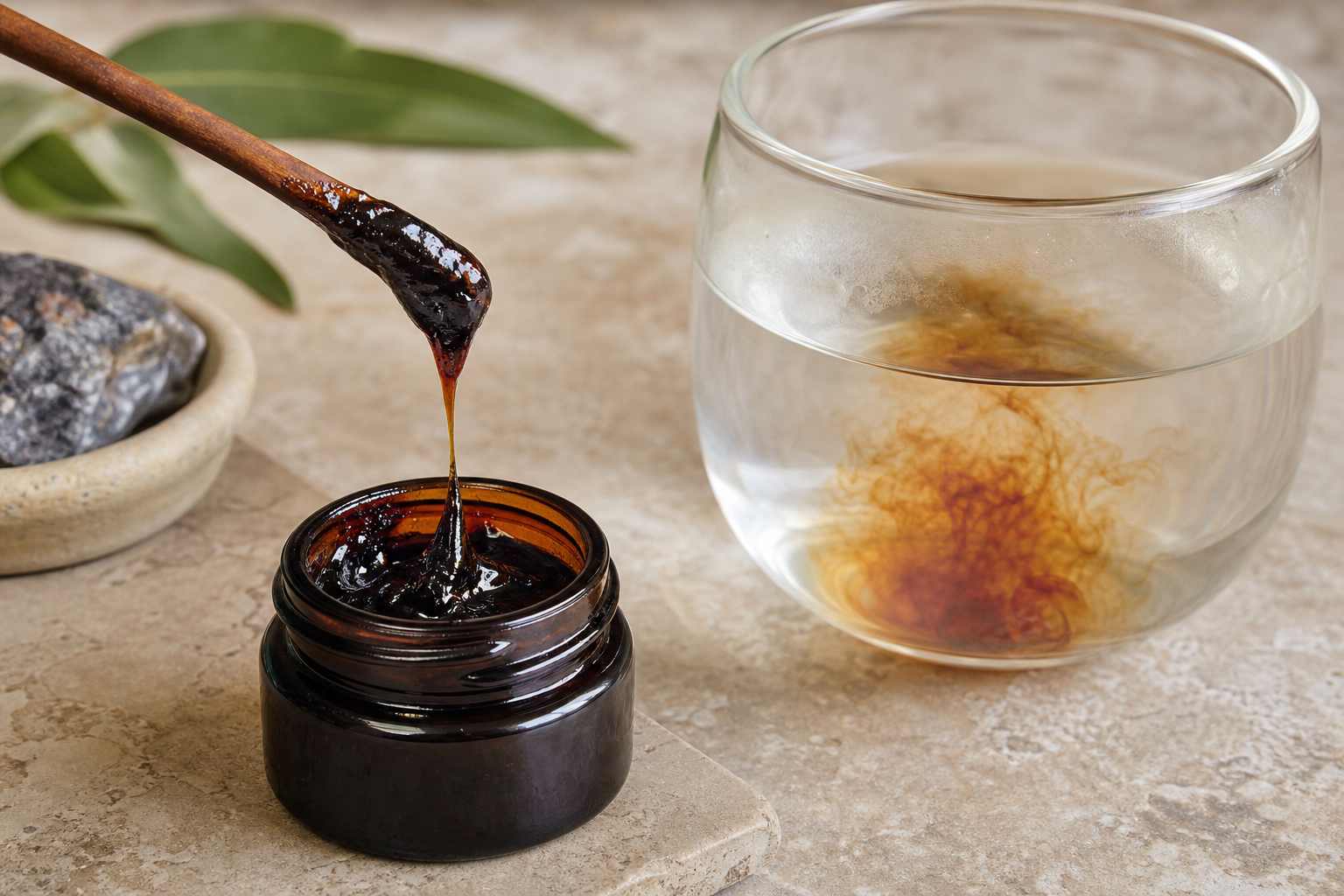
Notice the aroma, taste and warm-water behaviour
Traditional resin has a strong earthy, mineral, smoky or humic character and a bitter taste. A small label-directed amount should gradually disperse in warm water, often creating a brown or amber tone. Added fragrance, sweetness, neon colour or an oily film are reasons to question the product. Again, solubility is a screen, not a purity certificate.
Inspect every line of the packaging
A serious pack should show the net quantity, batch or lot number, manufacture and expiry or best-before information, storage and usage directions, responsible business details and the relevant licence or regulatory identification for the way it is sold. The tamper seal should be intact. Vague front-label claims should never replace this information.
Demand a batch-specific laboratory report
The report should identify the tested sample or batch, testing laboratory, report date, methods and actual results—not only the word “PASS.” Because Shilajit is a mineral-rich environmental substance, buyers should look closely for heavy-metal screening, especially lead, arsenic, mercury and cadmium, together with relevant microbiological testing. Match the report number to the pack.
What a useful Shilajit lab report should tell you
It belongs to your jar
The product name and batch or lot should match the pack. A report for a different batch—or a generic certificate reused for years—does not answer the buyer’s question.
It identifies the laboratory
Look for the laboratory name, report number, test date, sample dates where provided and the analytical methods used.
It reports contaminants
Results for relevant heavy metals and microbiological quality are more meaningful than a marketing-only fulvic-acid percentage.
It shows numbers and limits
A useful report lists actual results, units and reference limits. If you cannot understand it, ask the seller to explain it clearly.
Why HarvestLo prefers Himalayan Shilajit resin
For a buyer who values authenticity, resin has an important advantage: it keeps the material visible. You can observe its texture, aroma and dispersion and use a small amount according to the pack directions. Capsules win on convenience, but they ask the buyer to trust what is hidden inside. Powder is easy to mix, yet it is also difficult to judge visually.
That is why our premium recommendation is a well-presented Himalayan Shilajit resin supported by transparent product details. The resin format does not automatically make a product genuine; it simply gives a careful buyer more information before purchase. The deciding factor remains the evidence behind the jar.
Use Shilajit responsibly
Follow the directions and serving size on the current product pack. Do not use Shilajit to replace prescribed treatment or delay medical care. Speak with a qualified healthcare professional before use if you are pregnant or breastfeeding, under 18, take medication or have a medical condition. Stop and seek advice if you experience an unwanted reaction.
This buyer’s guide explains product checks; it is not medical advice and does not claim that Shilajit prevents, treats or cures disease.
The final verdict
The best-looking jar is not necessarily the most trustworthy one. Original Himalayan Shilajit should be approached as an evidence-backed purchase: inspect the resin, question the source, read the pack and match the batch to a meaningful report. When those pieces align, resin is the most compelling premium format for buyers who want character they can see.
Explore HarvestLo’s Shilajit selection and current product details.
Frequently asked questions
How can I tell whether Shilajit is original?
Check its resin form, natural texture and warm-water behaviour, then verify the source, complete packaging and a recent batch-specific laboratory report. No single home test proves authenticity.
Is Shilajit resin better than capsules?
Resin is easier to observe and offers flexible label-directed use. Capsules are more convenient and can also be well made. Quality evidence matters more than the format alone.
Should original Shilajit dissolve completely in water?
Good resin should disperse in warm water, but natural composition and processing can affect appearance and minor residue. Dissolving is not enough to prove purity.
Does the burning test prove Shilajit is genuine?
No. A fire test is unreliable, can be copied by substitutes and does not detect contaminants. It may also expose you to unpleasant fumes.
Which tests should appear in a Shilajit report?
Look for a matching batch identifier and relevant contaminant results, including heavy metals such as lead, arsenic, mercury and cadmium, plus appropriate microbiological tests. The report should identify its methods, units and laboratory.
Can everyone take Shilajit?
No supplement is suitable for everyone. Follow the label and consult a qualified healthcare professional if you take medication, have a health condition, are pregnant or breastfeeding, or are considering it for a child.