Raw Honey Buying Guide: How to Choose Pure, Unprocessed Honey
Learn how to choose pure raw honey, understand natural crystallisation, compare processed and unprocessed honey, and discover what makes HarvestLo Kashmir Raw Honey stand out.

Raw Honey Buying Guide: How to Choose Pure, Unprocessed Honey
Shopping for honey should be about more than colour and thickness. Learn what “raw” and “unprocessed” really suggest, why crystallisation is normal, and which details make one jar more convincing than another.
The quick answer: choose honey by its ingredient list, origin, processing information, sealed packaging and traceable seller—not by viral home tests. Raw honey is usually minimally handled, but it can crystallise naturally. A jar that turns cloudy or grainy is not automatically fake; floral source, temperature and the natural glucose-to-fructose balance all affect how quickly crystals form.
What does raw and unprocessed honey mean?
Honey is the natural sweet substance made by honeybees from flower nectar or plant secretions, transformed and stored in the comb. In everyday retail language, raw honey generally means honey kept close to its hive form, without intensive heating or ultra-fine filtration. Unprocessed usually signals minimal handling after extraction.
Those words are useful, but shoppers should still ask what actually happened: Was the honey heated? Was it only strained to remove larger wax pieces? Was anything added? Different sellers can use broad marketing terms differently. A responsible jar supports the front-label promise with a clear ingredient list, origin information, batch details and preparation or storage guidance.
Minimal handling is most valuable for the sensory experience: floral aroma, seasonal variation, natural colour and texture. It does not turn honey into a medicine, and “raw” should never be used as a substitute for food-safety standards or honest labelling.
Pure raw honey can crystallise
Honey is a concentrated solution of natural sugars, mainly glucose and fructose. With time, some glucose can come out of solution and form crystals. Penn State Extension explains that honey higher in glucose crystallises faster, while honey higher in fructose tends to crystallise more slowly; temperature and tiny particles such as pollen can also influence the process.
So “it never crystallises” is not a reliable purity promise. Some honeys can remain liquid for a long time—especially varieties with a naturally higher fructose balance—but any genuine honey may eventually change texture. HarvestLo’s label uses the more honest wording: “naturally crystallises.”
Raw honey vs regular processed honey
| What to compare | Raw or minimally handled honey | More heavily processed honey |
|---|---|---|
| Heating | Usually avoids intensive heat; ask the seller for specifics | May be heated to aid bottling, clarity or consistency |
| Filtration | May be strained while retaining more fine natural particles | May be finely filtered for a very clear appearance |
| Appearance | Natural variation, occasional cloudiness or crystals | Often designed to remain visually uniform for longer |
| Flavour | Can show more seasonal and floral character | Often selected or blended for consistency |
| Crystallisation | Can occur naturally and may happen sooner | Heating and fine filtration can delay it |
| Best reason to choose | Origin, aroma, texture and minimally handled character | Predictable look, pourability and mass-market consistency |
Neither colour nor thickness alone tells you which column a jar belongs in. Honey can naturally range from pale gold to deep amber, and cool temperatures make it more viscous. A light, runny honey is not automatically diluted; a dark, thick honey is not automatically pure.
The 7 checks before you buy honey
Start with the ingredient list
For a plain jar of honey, the ingredient declaration should be uncomplicated. “No added sugar” means no sugar or syrup has been added to the product; it does not mean honey is sugar-free. Honey naturally contains glucose, fructose and other sugars.
Look for a meaningful origin
Geographic and floral origin can explain why one honey tastes light and floral while another is darker or more robust. “Kashmiri honey” should offer a clearer origin story than an anonymous blend. Origin is about flavour and traceability—not a licence for exaggerated medical promises.
Read the processing statement carefully
Raw, unheated, cold-extracted, strained and unfiltered are not identical terms. Prefer a seller that describes its handling plainly. If the front says “raw and unprocessed,” the rest of the pack should not hide behind vague language.
Check the mandatory pack details
Look for net quantity, batch or lot number, packed-on or best-before information, seller or packer details and applicable FSSAI information. A tamper-evident seal and food-safe container protect the jar after it leaves the producer.
Accept natural variation
Honey changes with flowers, season, temperature and storage. Colour differences, a cloudy appearance or a crystallised texture can all be natural. Perfect sameness across every harvest is not the only sign of quality.
Do not trust viral home tests
Water, thumb, flame, tissue and ant tests cannot reliably prove purity. Moisture and viscosity vary naturally, while sophisticated adulteration is a laboratory question. Use home observations to notice an obvious problem—not to issue a purity certificate.
Choose the seller, not just the lowest price
Good honey involves beekeeping, careful extraction, storage, packaging and testing. Price alone proves nothing, but an implausibly cheap jar with no origin or batch transparency deserves more questions. A credible seller makes the buying evidence easy to find.
Why Kashmiri honey is a compelling choice
People often begin by searching for “pure honey” and then discover that origin changes the entire experience. Kashmir gives honey a memorable geographic identity: mountain valleys, flowering orchards and changing seasonal flora. The practical benefit for a buyer is not a miracle cure—it is a more distinctive story of place, aroma and harvest character than a generic jar offers.
A light Kashmiri honey may taste delicate and floral; a multifloral harvest may be more layered. The exact colour, flavour and crystallisation speed depend on the nectar sources and batch. That variation is part of choosing a natural food, and the label should tell you what the seller can genuinely support.
Why HarvestLo earns a closer look
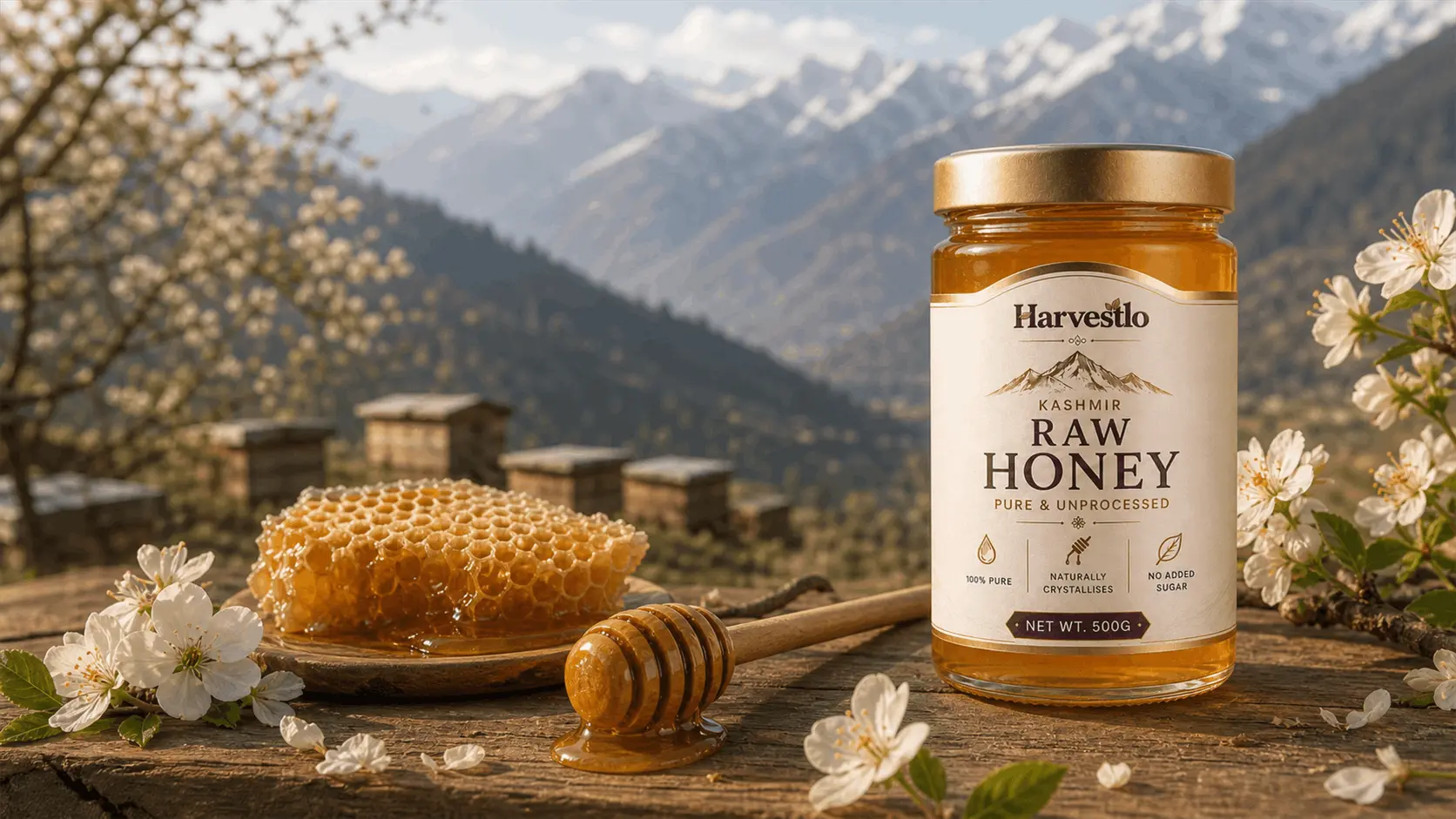
HarvestLo’s Kashmir Raw Honey pack puts the points a serious honey shopper wants to see directly on the front:
The Kashmir identity adds provenance and premium shelf appeal, while the glass jar and sealed metal lid protect the product and make its natural colour visible. For someone comparing a vague supermarket blend with a clearly positioned regional honey, HarvestLo presents the more memorable and transparent choice.
Explore HarvestLo’s Kashmir pantry collection.
How to use raw honey without hiding its flavour
Stir into comfortably warm tea or kahwa after brewing.
Drizzle over porridge, yoghurt or toast.
Balance mustard, lemon or vinegar in a dressing.
Try a small spoonful to notice aroma and finish.
If your reason for buying raw honey is its delicate aroma, avoid cooking every spoonful at high heat. Add it after a drink has cooled slightly, or use it as a finishing ingredient. Heating for a recipe is not “wrong”; it simply makes the honey’s subtle floral character harder to notice.
Storage and gentle decrystallisation
Keep honey tightly closed at normal room temperature, away from moisture, direct sunlight and strong odours. Use a clean, dry spoon. Refrigeration is usually unnecessary and can encourage a firmer texture.
If the jar crystallises and you prefer it liquid, stand the closed container in comfortably warm water and stir occasionally. Use gentle warmth and patience rather than aggressive boiling or microwaving. Crystallised honey is also perfectly enjoyable as a creamy spread.
Frequently asked questions
Does pure raw honey crystallise?
Yes. Crystallisation is a natural process influenced by the honey’s glucose-to-fructose balance, floral source, temperature and suspended particles. Some varieties crystallise quickly and others remain liquid much longer.
Is crystallised honey spoiled?
Not by crystallisation alone. If the jar has been stored correctly and shows no signs of fermentation or contamination, the change is usually only texture. Follow the best-before and storage directions on the pack.
What is the difference between raw and unprocessed honey?
The terms often overlap. Raw usually suggests honey kept close to hive form without intensive heating; unprocessed suggests minimal handling. Because sellers use the words differently, read the full label and ask what processing occurred.
Can colour or thickness prove honey is pure?
No. Both vary naturally with floral source, season, moisture and temperature. Purity is better judged through traceable details, applicable standards and reliable laboratory analysis.
Is “no added sugar” the same as sugar-free?
No. Honey naturally contains sugars. “No added sugar” means the product claims no sugar or syrup was added beyond the honey itself.
What makes Kashmiri honey different?
Its appeal comes from geographic provenance and the floral character of Kashmir’s valleys, orchards and seasonal forage. Exact flavour and crystallisation behaviour depend on the particular nectar sources and harvest.
Can I give raw honey to a baby?
No honey—raw or processed—should be given to children younger than 12 months because of the risk of infant botulism.